Thursday, November 8, 2012

If there are no questions, then there is no understanding.


On the utility of if/then questioning strategies in the development of cognitive facility. 

National and state standards are a known. They are fixed. They represent discrete bits of knowledge and/or skills that students should master in a given academic year as a way to provide a uniform education. The advantage to applying a uniform set of standards is that professionals see clearly what is expected and where children should be, developmentally, as they move through the system. The disadvantage to applying a uniform set of standards is that professionals are given their marching orders, as it were, as may see their job as one of ensuring children master conjugation or spelling, for example, without regard to how these skills apply to the why of education. 

The why of education. Simon Sinek suggests that, far too often, we focus on the how or the what of the things we do in our jobs rather than beginning with the why. By beginning with why, Sinek suggests, we ensure that others will more easily see the bigger picture of what we do or how we do what we do. Essentially, beginning with the why others will quickly see the “method to our madness,” to paraphrase the Bard.

The “why of education” can be seen as a marriage of social, emotional, and cognitive growth so that at the end of high school a young person may enter the adult world of commerce or service as a productive citizen. And yet, though we may believe in this idea of social, emotional, and cognitive growth, the reality of our nation’s educational agenda is squarely aimed at children’s cognitive growth. Unfortunately, mastering standards (e.g., solving an algebra problem on a standardized examination) is not equivalent to approaching a real-world problem from an algebraic point of view. This algebraic point of view, this perspective, is not related to skills or algorithms that can be applied so much as it is related to looking at a problem logically. If problems are a problem to be solved, then a requisite cognitive ability is to play with the problem’s variables apart of resolving or solving the problem

Therefore, if the why of education is our first and foremost concern for children, and developing their ability to approach problems or questions from different perspectives or different points of view, then all education, especially early childhood education, should present children opportunities to consider if/then questions. Unlike moving toward a known standard (e.g., fractions), approaching the concept of fractions through a series of if/then questions provides children opportunities to play with the idea rather than being bogged-down with definitions or symbols. If perspective-taking or altering a point of view is an important requisite of all education, it might be that we should focus our attention on simple conversations that employ if/then questions.

Thursday, July 26, 2012

On Habits and Journeys and Change

A journey of a thousand miles begins with a single step. 

This oft quoted phrase was written by the Chinese philosopher Lao-tzu (604-531BC). The beauty of this saying is that the physical change of traveling a thousand miles can be seen as a metaphor for a corresponding change of perspective, a change of thinking, or a change of values. It's this cognitive change that interests me.

If life is a journey, then all aspects of life are part of that journey. We are a whole. We might try to compartmentalize our lives to make things easier to handle on a daily basis and yet, those compartments are part of the whole. If the whole of our beings is on a journey, then it seems logical to assume that all of our compartments are journeying with us, modifying and adjusting and changing. Most things in life follow this pattern except for some institutions.

Consider the institution of education. The profession has survived many storms and stresses of popular and political upheavals and continues, unchanged and unscathed, to operate in largely the same way since the Nineteenth Century. Pedagogical methods and mindsets remain rooted to a core set of educational values that operate within a rigidly defined script. Professional practices and routines can serve as a grounding force when the electrical energy of public school education becomes overwhelming. We've all experienced the "Hang-on for dear life" moments throughout our careers.

And yet, is "hanging-on" best practice whether in mathematics or music? If life is a journey that begins with a single step, then the journey of pedagogy begins with a single try, taking a single chance a doing something differently.

Below is the reflection of a young choral music professional who gave something a try even though she had no reason to think that it would be successful based upon her pedagogical training and experience. The reflection relates to an assignment she completed for an introductory course in Dr. Edwin Gordon's Music Learning Theory.


    • So I met with my choir yesterday and presented them with my lesson plan for my assignment.  We prepared to do a sight-singing exercise by singing a I-IV-I-V-I cadence using solfege syllables.  We sang it a couple of times to make sure they 'got it in their ear'.  We then did a sight-singing exercise which was a SSA piece, 4 pgs long, not very difficult but they still had to think about it.  I had the students write down in a few sentences whether or not they liked this 'new way' or not and why.  My hypothesis was that they would like the old way we did things.  Much to my surprise a majority of them preferred the 'new way'.  Their reasons were varied but most agreed that they felt they had a better foundation of what they were about to sing.  They felt more prepared.   Gordon 1  Baez 0.
In the immortal words of the great bard Dr. Seuss, "You do not like it, so you say. Try it! Try it! And you may!"

Tuesday, July 24, 2012

Anchors and Global Warming

We all need stability in our lives. We all need to be grounded or rooted. In the currents that run through our professional lives it's important to have an anchor to keep us from drifting. Depending on the size of the vessel, anchors can big or small. For music educators, small anchors may be particular pieces of music or particular styles/genres of music. Those big anchors may be a particular pedagogy or curriculum that has stood the test of time. With all the changes that take place over the course of a career we might lose our focus if not for a curriculum that is steadfast and true.


Imagine that, as a young professional, you anchor your career in "this way of doing things" or "that way of thinking." And, with the gentle ebb and flow of the tides things are peachy-keen, they are copacetic. You have a solid anchor and an anchor chain that allows you to move up and down with the tide.


But what happens when the currents of change become more noticeable? What happens when, due to global warming, the oceans of your professional life rises? Your anchor and your anchor chain are fixed and inflexible. They cannot move and your ship is trapped in the rising waters with few options.  It's a scary thing to see the world rise about you, slowly filling your professional boat with the waters of a sea of change. You do what you can but the reality is that your ship will sink.


Lucy Green, among others, asks us to consider adding a bungee cord to our anchor chains. The global economy and the 21st Century Learner are melting the polar icecaps of Nineteenth and Twentieth Century pedagogy, causing things to change dramatically. By adding a nice length of very flexible cord to our anchors we can more easily rise with the waters that will force us to think differently about how to anchor the value of music in the hearts and minds of our students and our nation. 

Friday, July 20, 2012

A New Role

Is is possible that those of us who choose to be music teachers and ensemble directors chose our profession because of its non-musical aspects? For example, let's be honest, to have any effectiveness in getting 25 to 100+ students to cooperate takes a lot of leadership and management skills that have more to do with a Fortune 500 company than they do with the art of music. Another quality of teachers and directors/conductors is control. Is it possible that we choose to work in public schools because we like to control and micromanage things? Are we a bit obsessive compulsive and tend to exhibit Type A personalities?


Lucy Green asks us to reflect on our roles in the classroom and rehearsal hall, and consider adopting a new role. To adopt a new role requires that we change the way we think about our role, which is difficult. However, even if we wanted to change our role, would our administrators or parents want us to change? After all we're in a service profession and we serve the expectations of our community. If this is so, is change possible?

Just something to think about.

Wednesday, July 18, 2012

Digital SLR Cameras and Garage Band

This week I've enrolled in a digital photography class at the Fairbanks Summer Arts Festival. If you know anything about the basics of photography, then you've heard about the triangle of aperture, shutter speed and ISO. Essentially, from a technical perspective, the perfect picture is just the right combination of all three of these. But this represents just one aspect of the art of photography. You might say that these are the photographic equivalent of the National Standards in education. They are just "nuts and bolts," "knowledge and skills."

Sure most individuals simply want to "snap and go" with a $700 camera but there is more to it than that, isn't there? There's composition, what's in the frame. There are the elements of visual art (shape, line, color, pattern, etc). These represent more than the knowledge and the skills. They represent the imaginative and cognitive side of taking pictures. These relate to artistic vision, understanding how to communicate effectively via visual media. In order to capture a moment that everyone is drawn to, a photograph that takes their breath away, it takes something more than knowing ISOs or shutter speeds or f-stops. It takes a human mind that sees something is a way no one else can.

When you see a photograph that is stunning it's probably because the photographer took the time to think and consider, and not one who was "snap happy." The same idea is true for those who use Garage Band. Sure, kids and adults can put sounds together so that the elements of music (rhythm, melody, harmony, form, and instrumentation) work together but that's just the "nuts and bolts" of music, it's the National Standards of music. What's missing in these types of thrown together, point and click compositions/creations is the cognitive and imaginative side of the art of music.

As technology pushes traditional approaches to music education to the periphery, rest assured that it cannot replace the cognitive, imaginative, and innovative mind. And, if this is so, then might we want to begin highlighting and educating those aspects of musical interaction and cognition that no machine can duplicate, especially when we consider that technology grows exponentially?

Graphic taken from: http://www.nobadfoto.com/understanding-exposure.html

Friday, July 6, 2012

A Latter Day Liszt

Last night I attended what I consider to be one of a handful of performances that were breath taking and exhilarating musical events.


We often showcase those with exceptional talent as a way to motivate others to practice hard."One day, if you practice hard each day, you'll be as good as her."


The truth of the matter is that we really don't know for certain if this is true. Some people develop their "chops" with minimal practice, for others, it requires that magical 10,000 hours of practice.


However, sooner or later most children and adolescents realize that they don't have what it takes mentally or physically to achieve technical greatness on an instrument or with their voice. So what do most do? Quit.


Question: Are we shooting ourselves in the proverbial foot when we hold up exceptional talent as the goal to which children should aspire? After all, most weren't born with that talent.


Think about this in terms of writing. If everyone aspired to become William Faulkner or Tennessee Williams or bust, we would have a country of broken people. However, the idea is that you can enjoy creative writing regardless of your skill set. Is the point that language arts teachers try to instill in their students that they can become the next Walt Whitman or Mya Angelou? No way. It's that they can ENJOY the creative act of writing poetry for the rest of their lives.


Do most children and adolescents imagine that they will be world class performers someday? Probably not. Are most children and adolescents in musical ensembles for the music? No. They are in them to be with their friends and to enjoy doing something with them.


For the vast majority of people, music is a social activity that is much less tiring and much more enjoyable than running a marathon. Some may disagree. And yet, it's when we are in the company of others engaging in a common hobby or activity that we find joy in our daily lives.


If this is reality, as I suggest it is, might we modify our educational agenda to feature less "tour de force" performances and more communal music making? After all, most of us are average, right?


If this idea somehow gets stuck in your craw, chew on it awhile. 

When Excellence is Average

Last week I was walking my dog around our neighborhood and happened to pass our local high school's marquee.  The sign is fairly standard one with flashing, multicolored words and images, announcing the next ballgame or students' accomplishments or the teacher of the week.


What caught my eye was the announcement that one of the music ensembles received an "Excellent" contest rating and that this meant that it had risen to the distinction of earning "Sweepstakes." Being awarded Sweepstakes is a big deal in Texas. As I stopped to read through the several images that contained the announcement I thought to myself "Well done. Good job. You see, hard work and perseverance do pay off." This feeling of pride for the students and their directors was muted a bit as I read the last statement of the announcement "...37 years in a row!"


Question: After 37 years, might we assume that the band will receive Sweepstakes next year and the year after and the year after ...? So, logically speaking, if we can predict with almost certainty that this band will achieve the highest rating in the state and nothing higher because there isn't anything higher, then can we make a case for advertising that the band had an average year next year? After all, isn't average what you do most of the time? AND, if average is all this band will ever hope to be in the future, can't we think of something more productive to do with their time?


Just some thoughts.


Compliant, Engaged, or Mind-full.


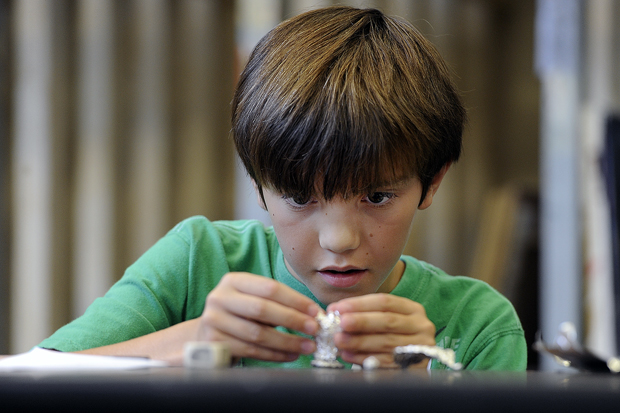
No one would doubt that this young man is thinking. He is "engage" in creating a "meaning-full" representation of his thinking.
Recently I spoke with the principal of a local elementary school who had just returned from the Model Schools Conference 2012 in Orlando. As we chatted it became clear that the central message of the conference was discerning the difference between an education of compliance and an education of engagement. Since I'd been thinking about these ideas, I began poking around the Internet and with a bit of sleuthing I found dozens of sites and opinions on what differentiates students who do as they are told, AKA-compliant, and students who are engaged.

There is little controversy over what constitutes an engaged student and yet, I wonder if current wisdom or best-practice is at odds with what we desire, cognitively engaged students ready to think.  Edutopia, for example, published an article on compliance and engagement that offered the reader several ideas on how to engage a classroom full of students who are "sleepwalking," as it were, through the day. In the article, the author offers "ten smart ways to increase classroom participation."  Of these ten I want to target the first two: 1) start class with a mind warm-up and 2) use movement to get kids focused.
As you know, the brain develops from the brainstem to the cortex. What we consider a "mind warm-up" is focused on activating the cortex rather than focusing on activating the "whole enchilada" of the brain. Recall that a significant portion of children's lives was spent learning via non-verbal gross motor modalities. It seems logical that to engage children we should begin with their most practiced mode of learning and thinking, non-verbal movement. Additionally, it bares repeating, the higher order thinking (active cognitive engagement of the cortex) is the result of all the experiences and information the body (sight, sound, tactile, smell, visceral, taste) has collected and stored in the cortex. Therefore, above all, movement should be the thing we begin with, not mental gymnastics.
Okay, so if you're on board with this idea of movement, then the next question is what types of movement engage the mind? Here I argue that in the world of movement there are those that are mind-less and those that are mind-full. My guess is that most children are engaged in mind-less movement activities that do not promote intellectual engagement or contribute to meaningful conversations which support the development of higher order thinking.
In the article the author offers several suggestions as to how teachers might incorporate movement throughout the day "because most kids find it invigorating and it's easy to monitor full participation, it may become one of your favorite ways to get kids focused and kill dead time." Here are a few selected activities: Younger children: hand-clapping to accompany a set of math facts; Older children: rhythmic finger snapping in a leader/class echo format. These are time-honored and child-tested activities that work.
I ask you to consider the point of the movement activities. Was to stimulate the children's higher order thinking or was it used to wake them up? Simply because snapping and clapping are preferable to listening to someone drone on and one, is it mind-full or an aural "spoonful of sugar" to help bring their minds back to the business at hand?
I do not think that most of the movement activities that are considered best-practice contribute to children's intellectual development in an meaningful way. Certainly they provide entertainment, they make it easier to memorize facts and figures, they help us transition from here to there, and yet, when all is said and done, they are simply used as an artificial sweetener, a Spoonful of Sugar, for the knowledge and skills their compliant bodies must master. You see, in the end, children can engage physically with movement and be cognitively compliant. The trick is to provide movement opportunities that not only exercise their bodies but also excite and stimulate their thinking.
Just something to think about.

Saturday, October 8, 2011

The High Cost of Perfection

Growing up in Fairbanks, Alaska I wasn't part of any marching band. Well, I was in a very "Alaskan" sort of way. I can't recall that we ever went onto the field except to stand there and play. Most of my memories of football revolve around shivering in the stands wondering when I could back into my warm car. My most vivid memory of actually "marching" was in the annual Fur Rendezvous Parade. It's the celebration that ends with the start of the Iditarod and, oddly enough, is in March. Imagine marching a four mile parade route at 25 degrees. Without a doubt, that musical experience sent shivers through my body.

You can imagine my surprise when I came to Texas and experienced the deadly seriousness of marching competitions. Perfection on the field is not something to be hoped for or to be wished for; it is expected. I'll admit that seeing a group of 200+ individuals marching with precision is a wonder to behold. I wouldn't rank it up there with Mahler's Second Symphony, but it's a distant third or fourth. The difference between a professional orchestra playing Mahler and a high school band playing Sousa is that professionals are professionals and high school musicians are children.
"Having the time of our lives."
3rd Quarter Friday Nights
For better or for worse, competitions are the benchmark by which we evaluate our music programs, our success at teaching, our students at mastering a difficult piece of music, and how we're doing professionally compared to our peers. In my experience with competitions in Texas, if you do not receive a contest rating of a I or a II, something's up. Like every other aspect of competitive life, winning or securing the highest ratings is a primary motivator for many children and adults alike.

As a testament to success, being awarded "Sweepstakes" for your marching band or concert band or choir or orchestra is like winning the Triple Crown of Texas public school music competitions. That is the ultimate goal and with one word, "Sweepstakes," you know you're doing well, your ensemble is doing well, and that you can count yourself among the musical elite of public school music directors. So, if that is the goal or the end, then the means by which we get there are of limited importance. After all, no one wants to see chaos on a football field. Marching is about order and precision. I get that.

And yet, I have to ask "At what cost?" We're talking about children and not about professionals. Children are in school to learn, ostensibly, from their mistakes. However, what if their mistakes warrant some form of punishment? Okay, I get that as well. There must be consequences. And, what if the punishment is open to the public and not in the privacy and security of the school building? Here I have some concerns not only for the child but also for music education in general.

A few weeks ago I visited an good friend in the Dallas area whose son is in a high school marching band. Towards the end of October all the bands in the state will perform and compete in the annual marching band contests. As we chatted about her son's involvement in the band program my friend told me that the head band director requires every band student to memorize their music. Okay, fair enough. Then she told that the punishment for not doing this is to stand with your back to the field going over the music you hadn't memorized at the next football game. Well, now I'm beginning to feel at bit uneasy about the situation, especially when I found out that they stand there for the entire third quarter while those who have passed this hurdle are allowed to take a break during and share food and laughter with their friends. She told me that her son said to her "I'm never going to have that happen to me." He was one of the first students to pass off his music.
I wonder...
  • Was he motivated by joy for making music or fear of being seen as one of the losers in public?
  • Is fear and ridicule the best way to advocate for the joy of actively making music when you're 43?
There is a lot of pressure that goes with high-stakes occupations, be it a Superintendent, a Principal, a coach, or an ensemble director. Excellence, and not mediocrity, is the watch word. I get that. However, think and reflect; at what cost do we badger and bully children in our musical ensembles to excel? To my knowledge ridicule is not one of the three Rs.

Might the child who has difficulty memorizing anything, let alone music, and, as a consequence is punished for it, grow up to sit on a school board deciding the fate of fine arts education? Are short term gains worth the long term costs to music and music education in our society?

Friday, October 7, 2011

Who Will Buy?

The second act of Oliver opens with a wonderful scene of street vendors hawking their wares as the orphan Oliver looks on. The scene is joyous and raises the question “who can buy the wonder and joy of this bright morning?” Well, no one. The joy of that scene and that moment in Oliver’s life must be experienced. No amount of money can buy his feeling and I wonder if we sell ourselves and our art short and send a wrong message to our students when pull out our pocketbook or wallet instead of pulling out a pencil and paper?
The other day I met Monica, a student of mine, in front of our local music store. I was headed inside to buy a guitar strap and she had just come out with some piano music. As we chatted I asked her about the music she bought and found out that, in addition to studying the French horn, she also taught piano lessons. Monica showed me the Halloween pieces she was going to assign her student, Hazel. Since the composer’s name was also Hazel, Monica was excited to see the joy on the child’s face when she read her name on the music. As I recall, the composition looked similar to this:
Monica is bright, as are all my students. So I asked her
“Could you have written a short Halloween piece for Hazel that is similar to this?”
“Probably.”
"How long would it have taken you to compose it?"
"Not long."
“Well I wonder how she might feel if, instead of saying ‘Here, I bought this for you,’ you said ‘Hazel, here’s your Halloween piece; I wrote it just for you’?"
In today’s consumer driven economy, buying things can be the easy way out. Many times it’s the best we can do. However, those that have the skill set to notate melodies, harmonies, and rhythms can bypass the somewhat impersonal act of thumbing through several dozen pieces of sheet music, for example, buying one and handing it to a student.
I wonder: Do the children for whom we buy all this music receive it as casually as they do a 'kids meal toy?' Is it something to be discarded once they’ve moved on to something else? How much more personally meaningful and musically meaningful might it be for the student if her piano teacher or flute teacher or voice teacher wrote something “just for her” and no one else?
Music is a gift, our gift. We did not pay for it. We were blessed with it. Shouldn’t we give to others the best part of our musicianship, our creative mind? The music that will mean the most to Hazel, I beleive, is that which was created in a musical relationship with Monica. Long after Hazel’s Halloween song has faded from Monica’s memory, Hazel may still be heard playing it for her grand children.
Music should last a lifetime.

Thursday, October 6, 2011

Is the Choice Music?

Is seems that those in music education and those who advocate for the musical arts in our culture are always complaining about the general public's apathy towards participation in music. After all, music is an enjoyable part of our lives, why can't the rest of the country get on the band wagon? Could it be that the general public has already been on the band wagon and took the first chance it could to jump off? If music is a band wagon, then getting on the wagon represents a choice. Likewise, deciding to jump off is also a choice. Do we need to reconsider musical participation from the standpoint of choice?

From where does music emanate? Is it external or internal? Is it an external action or an internal choice? Without choice there is no action. Without action there is no voice, only silence. Action is not a given; it is a choice. The choice we all make is whether or not to participate in music or to make music. It is the choices that people ultimately make about music in their lives that are a testament to our efficacy as musicians who serve our art. Consider my adaptation of one of Shakespeare’s famous soliloquies:
Sir Laurence Olivier
as Hamlet


      To choose or not to choose: that is the question:
      Whether ‘tis nobler in their minds to suffer
      The slings and arrows of short-lived perfection
      Or to walk away from a sea of troubles,
      And through distance end them? To make music,
      No more; and by this say they end
      The heart-ache and the thousand emotional shocks
      That soul is heir to, ‘tis a consummation
      Devoutly to be wish’d. To make music, no more.


Choose Music and You're Saddled with Perfection 

Music is akin to sport and sport is akin to dance or theater. All of these require a demonstration of competence or excellence. In sport we judge performances against a norm. On any given day the best team will have a superior performance and will win that competition. Even if the two worst teams competed against one another, one of them will win. However, the standard for evaluating the performing arts is not a norm but a criterion. Excellence is the standard in the arts. Winning is the standard in sports. Therefore, if four mediocre baseball teams compete, one of them will eventually win. However, if four musical ensembles present mediocre performances, they all lose in their quest for excellence. For you see, when we compete against fallible humans, there is a good chance we will win. But when we compare our performances against a perfect art, eventually,we all lose.

There is nothing inherently wrong with striving for excellence. Pushing ourselves to perform better than we have ever performed has many benefits, which include persistence, patience, and dogged determination, to name a few. And yet, when striving for a personal best is equated with perfection, the chances of turning someone away from every wanting anything to do with music increase dramatically. And because involvement in music in secondary school and throughout a lifetime is a choice, there is an excellent chance that the choice will be to avoid the emotional pain of musical participation at all cost; to make music, no more.

 A Different Road to Follow, A Path Less Traveled

Whether anyone embraces the notion that a rich and varied life should include musical action will depend on many things. Realistically, most of the things that will influence and impinge on musical decisions are out of our control. And yet, to throw our hands in the air and wash them of any responsibility for the musical future of our culture is untenable. We can make a difference if we choose to think about things differently. The central message here is choice—theirs and ours. A road ahead for us is to use “choice” as our watchword. Since we can’t force anyone to participate or make music, it makes sense that we musically educate others about the choices that can be made, and that they can choose to make, about music.

It’s a choice as to the types and styles of music we listen to, move to, or participate in making. You can get through life quite easily without interacting with music. Therefore, from an early age, children need to know that they can make decisions about the music they actively participate in. Music is about choice. A lifetime of active musical involvement is not a given; it’s a choice. The question that we must ask ourselves each and every day is “Will the music they make today make it more likely or less likely that they will choose to participate in music when they are 43?”

An Education by Choice

In the world of music, choices are neither black nor white. The appropriateness of a choice depends on many different things, such as style, context, and musical resources, to name a few. Educating students to make more appropriate choices is a matter of degree or successive approximation. Over time, and with support and guidance, students’ choices will gradually adhere to the standards of a particular style of music. However, they must recognize that 1) they are making choices, 2) they control the music that they make, and, in the end analysis, 3) they are responsible for the music that comes from their minds and through their bodies.

Active participation in music is a choice we can only make for ourselves. Choice is a personal decision. If we hope to alter the choices the public makes about music, might we want to consider limiting the number of musical choices we make for them when they are in our classes? Perhaps allowing students to make choices throughout their music education will inspire them to participate in music for the rest of their lives.

Friday, July 15, 2011

A Little Town in Northern Italy and Community

In the city of Reggio Emilia there are a group of early childhood educators who have changed the way many people envision education. The pre-school teachers who work in the Municipal Preschools of Reggio Emilia believe, among other things, that their schools must be an integral part of their local communities or neighborhoods. In a city that was designed for foot traffic rather than automobile traffic, this is more easily accomplished, logistically. At any rate, the idea is that the preschool and the community are in a relationship. The school is not seen as something apart from the everyday life of the community.
If this bond between school and community is important to the health and well-being of children’s education, then we might say that a similar connection should be part of each level education. And, if it’s important for each level of education, then it should be beneficial for each domain within education. Therefore, let us assume that a strong connection between music education and community is the ideal. The question we are left with is how might we accomplish this?
It’s easy to say “do this” and you will succeed; that mindset is folly. There are no silver bullets. Each community, each neighborhood, each school has its own unique social-cultural values. For example, a small community in the “bible belt” may not object to a musical celebration that combines the musical forces of local churches with those from the local schools. In another part of the country it might be that there is a strong tradition of Celtic music. Regardless of where we live and where we work and make music there are local communities of active participants in music that could enhance our students experiences by witnessing live music made by members of the local community.
In her book “How Popular Musicians Learn,” Lucy Green contends that making music once occupied a larger place in our society and that with a change of thinking and pedagogy, it can resume its place as a family and communal activity that all can enjoy. The question, then, is how might we change our thinking and pedagogy so that Green’s vision becomes a reality?

Tuesday, July 12, 2011

"Fairbanks is a Musical Oasis."

Shopping at Kroger the other day I ran into a colleague from work and we began to chat about my trip home to Fairbanks Alaska. I recounted my experiences with listening to the local youth symphony and stated that it was technically as good as our college orchestra. My friend made a comment that stuck with me. He said, “Fairbanks is a musical oasis.”
  • Let me give you some background on music in this part of the world. In Deep East Texas, if music isn't part of Friday night football, it's not supported. Therefore, choral programs struggle to maintain their place and orchestras are non-existent. An orchestra of any size is a rare and precious thing. One of the things that we struggle with at my university is to gradually influence the musical culture of East Texas.
Centrally located in Alaska, Fairbanks is 350 miles from Anchorage, pop 250,000, which has the size and money to support a vibrant fine arts community. And yet, Fairbanks, geographically isolated as it is, somehow manages to sustain a culture wherein the fine arts flourish. Some suggest that because this mid-sized city is miles from nowhere, that people must create and recreate art for themselves. While this may have been the case decades ago, with the ubiquity of the Internet and multimedia location should not hinder anyone from benefiting and enjoying any of the arts, including music.

Music and the other arts are alive in Fairbanks, more so than in other cities its size. So my question is why? Why does music continue to play such a strong role in Fairbanks when it seems to languish elsewhere? Is it the local culture? Lucy Green asserts that culture and society influence music making. Is it possible to suggest that because of its location and the pluck of the pioneer spirit (yes, I realize this is a bit cliché) exhibited by most everyone in the Golden Heart of Alaska that music has evolved its way into its cultural identity?

It seems that I may need to apply for sabbatical leave.

Thursday, June 9, 2011

Music, Appreciation, Spectators & Sports

Here is a musical Miller's Analogy-esc question for you to consider:

spectators : sports :: music : _____________.
  1. composition
  2. measures
  3. appreciation
  4. musicians
I suppose the title of this post might provide a hint as to my thinking. Spectators are to sports as appreciation is to music.

For many in the fine arts education, sports and athletic events are the bane of their existence. "Why are our positions cut when there are seven full-time coaches for a team that hasn't had a winning season in twenty-five years?" The disparity between the public's support of sport and their support of the arts is disheartening. So much time, energy, money, and moral is given to a very few, even when their performance is dismal.

Tempting as it may be, it is unfair to saddle physical education with the baggage of football, basketball, and soccer, to name a few, because sports and athletics are not synonymous with physical education. In truth, music education and physical education have more similarities than differences. Consider one of the most basic goals of a quality physical education, maintaining an active physically fit body.

Let's consider typical college or professional football fans. There are millions of people who can dissect a specific play and tell you why it worked perfectly or who missed his block, or can tell you what personnel should be on the field for a third and ten situation, or can predict what "move" can get the safety running the wrong way. There are millions of people who study and analyze scouting reports and injury lists, who read everything available on the Internet, who follow their teams on-line, on the television, and on the field. In one sense of the word, they are actively involved in sports and athletics. And yet, is this the activity that those in physical education advocate? I would say not really. I think we could agree that active participation in team sports or individual sports should be physical and it involves individual action. Watching a game from the comfort of an easy chair or a local bar or at a stadium is a spectator sport that requires little physical exertion and this may not be the same kind of active involvement in athletics that the Presidential Fitness Challenge hopes to influence.

But what about a fan of music? There are millions of people who can dissect a performance of a selection and tell you how it compares to the definitive performance, or tell you which parts were out of tune or out of time with the ensemble, or how they might have adjusted the tempo here or added a bit more rubato there, or how the choir's diction could have been improved. They can also rattle of a list of compositions by other composers that are far superior, or inferior, to the one that was just performed. There are millions of people who follow their favorite performing artists or composers on-line or on the radio or on the television. They can tell you their evolution as musicians and can compare and contrast an up-and-coming artist to a legend from the past. They even support their favorite musicians by purchasing concert tickets and audio recordings. So are they actively involved in music?

On the one hand, yes, anyone who alters their behavior to read, or attend, or buy something makes active decisions and can be said to be actively involved. Therefore, reading about musical artists or attending concerts or buying recordings is active involvement. On the other hand, these activities are similar to sports fans who support their team with their attendance. Therefore, should we reconsider what it means to be actively involved in music? If the Presidential Fitness Challenge encourages everyone to become active, to exert themselves for their overall physical health, then is it logical to challenge others to become active makers of music for their overall musical health? Could changing the way we envision our nation as consumers of music to a nation of active recreational music makers alter the way we promote lifelong involvement in music in our PK-12 compulsory educational system?

Tuesday, June 7, 2011

On Birthdays and Blessings

It's my older sister's birthday. As I get older, birthdays become points of reflection as well as celebration. This is the first time that I've been in Fairbanks in early June in the last twenty years. Typically I'm in Texas sweating like a pig. It's nice to be home for her birthday. To celebrate the day I've decided to compose her a birthday song. I enjoy writing lyrics and composing music. Much like Jason Mraz, wordplay is key to a good song and can be very useful in celebration and reflection.

So, I've got some decisions to make. What style/harmonic structure should I choose? Something with chromatic harmony? Maybe something that involves the circle of fifths? Maybe utilize some "blue notes?" Possibly something that modulates to an unrelated key? Or maybe something that involves third relations? Should it employ durchkomponiert? Should it have a riternello? Maybe the melody should have an appoggiatura or some other non-harmonic tone. Okay, enough of all that. I know enough to still pass freshman theory. Any yet, knowing all of these things and having the skill to utilize them effectively is not important to my big sister. Outside of our academic training in music is the vibrant world of everyday living and everyday people. One of those everyday people is my sister who recently lost her adopted son at the age of five to the flu and I will bet you that she really doesn't care a flip about all of that musical-techno-jargon. She will focus on the simple fact that her brother wanted to bless her with his musical talents by taking the time to write her a song.

Taking time to write a song. Taking time to hum a tune. Taking time to whistle a gig. Taking time, taking time, taking time. Making music takes time. Time is in short supply. Therefore, a key to promoting active musical lives is influencing how others use their time. Lucy Green challenges us to reflect on how we traditionally conceive of music education with the hope that, one day, our nation will have many more active makers of music.

Birthdays and other special days and events present us with opportunities to bless our families and friends with music of our own making, design, and performance. My thinking here is this: If we bless those closest to us with music, might they bless others?

Wednesday, June 1, 2011

If music is for a lifetime, when does that lifetime begin?

One of the central features of Lucy Green’s research and writing is that people learn to become technically proficient and develop musical artistry without going to school or by taking lessons.  There are millions of “used to be” band members, choir members, orchestra members. Even with the best pedagogy and curricula available, we don’t seem to be able to influence the musical futures of our students.
If music is for a lifetime, when does that lifetime begin?
I struggle with this question because I am in the business of schooling children in how to succeed in the “big three.” No, not our nation’s auto makers but the musical big three: band, choir, orchestra. And yet, I realize that for most of the children I work with, they will never choose to sing or play or move to music once they leave my studio. It is this reality that pushes and prods my thinking and my pedagogy. It is my belief that actively doing music is not something to be pushed aside along with yearbooks, kindergarten drawings, academic awards, that the like. Music is something worth doing as a recreational activity, similar to a pick-up game of soccer or flag football or a stroll in the park or a walk on the beach. And yet, we're not there but we could be. I'm confident.
Because I won't be in my students' lives for more than a few short years, developing in each child a sense of “I can do this myself” is becoming a more prominent element of my classroom interactions. Gone are the days of explicitly directing students’ actions. Instead I have opted for a less “in your face” approach that provides just enough scaffolding to get them started so that they struggle. The beauty of struggle is that it tends to be tied to thinking and persistence, both of which are in short supply in our culture’s modus operandi.
It seems strange that I would want children of all ages to struggle, to agonize, over how to successfully play or sing or create a familiar song but the benefits of their own realization that they indeed “did it themselves” is more powerful than anything I could have done. Maybe, just maybe, these little successes will influence the choices children will make about how to use their leisure time when they are 15 or 25 or 35.
If music is for a lifetime, should it begin today?